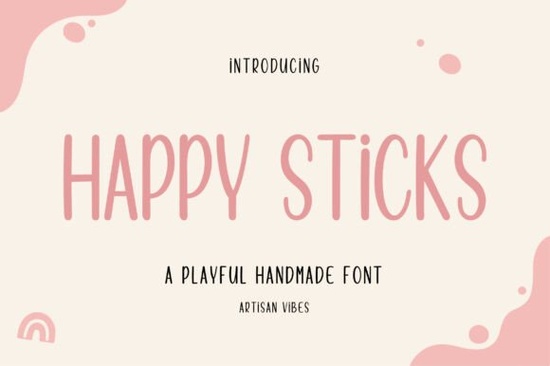
When you need a quick visual boost that feels personal without taking hours to draw yourself, Happy Sticks Font delivers exactly what modern crafters and small business owners are looking for. The tall, rounded shapes give your layouts an immediate sense of warmth, which is especially helpful when you are working on children’s party invites, boutique product labels, or weekend scrapbooking projects. Instead of fighting with stiff geometric characters, you get a complete set of uppercase and lowercase letters, numbers, and punctuation marks ready to drop straight into Canva, Adobe Illustrator, or your favorite laser engraving software.
Why does a hand-drawn typeface improve project readability?
Readability often gets overlooked when people chase decorative looks, but those slightly uneven edges actually guide the eye smoother across a page. The generous spacing between characters prevents crowding, while the consistent stroke weight keeps each symbol distinct even at smaller print sizes. For podcast cover art, classroom bulletin boards, or tote bag prints, this balance means customers actually read your message instead of guessing at stylized swirls. You also avoid the blurry halos that sometimes appear when thin script files get scaled down for business cards or sticker sheets.
How should you prepare your artwork files before exporting?
Setting up your design workspace matters more than most creators realize, especially when mixing handwriting elements with vector cut files. Start by locking your background grid so alignment stays predictable, then place your new characters on separate layers to adjust tracking quickly. Since the original package includes full numeric sets and standard punctuation, you can build complete sentences without searching for missing symbols. If your layout feels too dense, try switching to softer morning-inspired signatures for secondary text, which creates clear hierarchy without cluttering the main message. Always preview your artwork at actual print dimensions before sending files to your sublimation printer or cutting machine.
What practical applications bring out the best in these shapes?
This style shines brightest when matched with simple backgrounds that let the letterforms breathe. Craft vendors frequently pair it with kraft paper textures, watercolor washes, or muted earth tones to maintain that homemade feel. Packaging designers love it for snack boxes, candle labels, and gift wrap because the rounded curves echo the tactile nature of physical goods. For a cozier aesthetic, explore plush bunny-style lettering when targeting nursery markets. Social media managers use it for weekly quote graphics and event flyers since the cheerful tone stops scrollers mid-feed. Vinyl stencils and embroidery hoopers also benefit from the clean outer edges, which reduces weeding frustration on complex phrases.
How can you combine different lettering families in one composition?
Mixing type families works best when you respect contrast and share a common mood. A structured serif anchors headlines perfectly, while those soft handwritten strokes handle subtitles or callout quotes. Look into delicate floral brush collections for elegant accents, or test rustic autumn sets when designing seasonal harvest themes. The key is keeping line heights balanced so neither style fights for attention. You can always revisit this core toolkit whenever you need reliable fallback characters for tight deadlines. Place your primary message in bold block letters, then tuck supporting copy underneath to create visual rhythm.
Building confidence with custom typography takes practice, but starting with pre-made character sets removes the guesswork. You get professional kerning built in, proper file encoding for commercial projects, and enough variation to cover dozens of niche markets. When browsing further, consider checking out Happy Sticks to see the full alphabet sheet and download the ready-to-use installation package. Testing a few layouts with different color palettes helps you spot potential readability issues before committing to large production runs.
Print-ready designs demand attention to final details that often slip past during early drafts. Verify your bleed margins match your printer requirements, convert all text outlines if the vendor insists, and double-check license terms for unlimited commercial usage. Small touches like adjusting baseline shifts can transform a flat layout into something shelf-worthy. Run a sample print on your chosen stock material to confirm ink absorption and edge clarity. Adjust spacing only after testing full phrases rather than isolated words.
Before hitting export, run through this quick review:
- Confirm all required symbols, numbers, and punctuation loaded correctly
- Test scaling at both 10% and 200% to catch pixelation or distortion
- Check line height ratios against your background imagery
- Verify commercial usage rights match your project scope
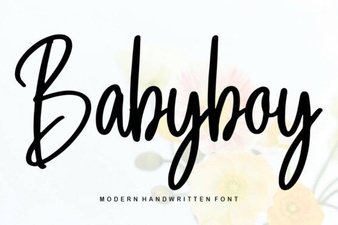 Crafting with the Babyboy Font: Design Ideas & Uses
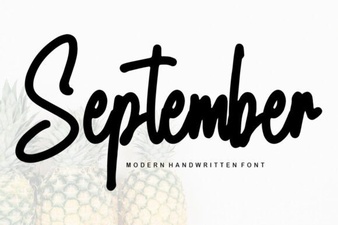 Choosing the Perfect September Font for Your Design Project
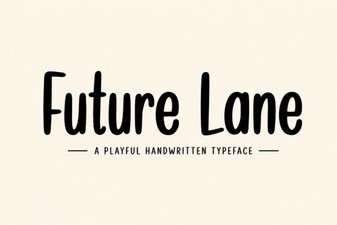 Future Lane Font: Creative Applications & Design Ideas
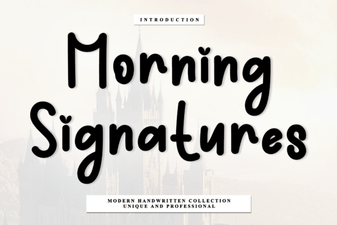 Morning Signatures Font: Creative Handwriting for Design Projects
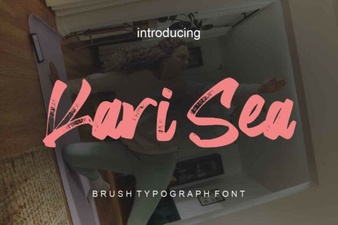 Kari Sea Font Download & Creative Typography Ideas
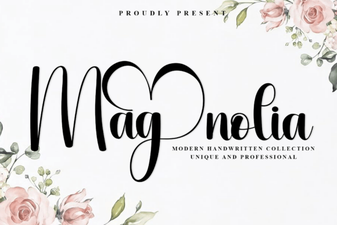 Elevate Your Designs with the Elegant Magnolia Font